
Teen Patti Master Hand Rankings
Six hands, highest to lowest, with the actual maths behind each one. Bookmark this page and you'll never misread a show again.

A 52-card deck gives you exactly 22,100 different three-card hands. Rarer hands rank higher, with one famous exception covered below.
The ranking ladder
Trail (Set)
Three cards of the same rank · 52 ways · 0.24%
Pure Sequence
Three in a row, same suit · 48 ways · 0.22%
Sequence (Run)
Three in a row, mixed suits · 720 ways · 3.26%
Color (Flush)
Any three of one suit · 1,096 ways · 4.96%
Pair
Two cards of the same rank · 3,744 ways · 16.94%
High Card
None of the above · 16,440 ways · 74.39%
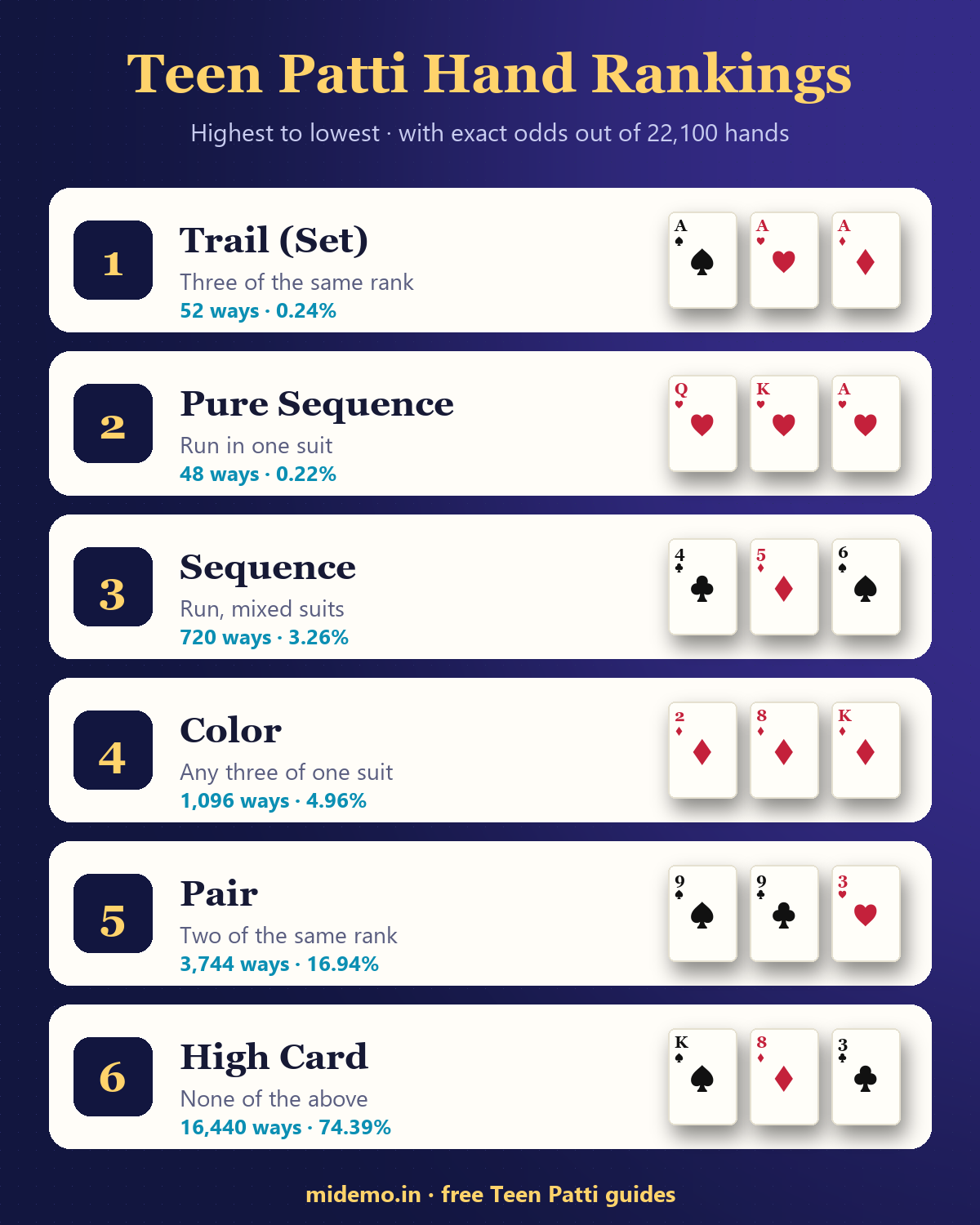
Combinations & probabilities
| # | Hand | Example | Combinations | Probability | Roughly 1 in |
|---|---|---|---|---|---|
| 1 | Trail / Set | A♠ A♥ A♦ | 52 | 0.24% | 425 |
| 2 | Pure Sequence | Q♥ K♥ A♥ | 48 | 0.22% | 460 |
| 3 | Sequence | 4♣ 5♦ 6♠ | 720 | 3.26% | 31 |
| 4 | Color | 2♦ 8♦ K♦ | 1,096 | 4.96% | 20 |
| 5 | Pair | 9♠ 9♣ 3♥ | 3,744 | 16.94% | 6 |
| 6 | High Card | K♠ 8♦ 3♣ | 16,440 | 74.39% | 1.3 |
| Total | 22,100 | 100% |
How the numbers work: a Trail needs three of the four suits of one rank (4 ways) × 13 ranks = 52. A Pure Sequence has 12 possible runs (counting A-2-3 and A-K-Q) × 4 suits = 48. Everything else follows the same kind of counting.
Tie-break rules for each hand
Trail
Higher rank wins: A-A-A is top, 2-2-2 is bottom.
Pure Sequence and Sequence
A-K-Q is highest, then A-2-3 (in most rules), then K-Q-J, Q-J-10, down to 2-3-4. Suits never break a tie.
Color
Compare the highest card. If equal, compare the second, then the third. So A♦ 10♦ 4♦ beats K♣ Q♣ 9♣.
Pair
The higher pair wins. If both players hold the same pair, the odd card decides.
High Card
Same as Color: highest card first, then second, then third.
An easy way to remember it
Think "Three, Pure, Run, Color, Pair, High." Better still, remember that the more matching a hand needs (same rank, then same suit plus order), the higher it sits.
Why rarer hands rank higher
Every ranking system in card games follows one idea: the harder a hand is to get, the more it should be worth. Out of 22,100 possible three-card hands, only 52 are Trails, but 16,440 are plain High Card. If High Card beat a Trail, nobody would ever bother betting on strong hands.
Teen Patti breaks this logic once. A Pure Sequence (48 ways) is actually rarer than a Trail (52 ways), but the Trail still ranks first. It's a tradition the game inherited and kept. Nearly every app and family game honours it, so learn it that way.
Every sequence, ranked
There are 12 possible runs. The same order applies to Pure Sequences and ordinary Sequences:
| Rank | Run | Note |
|---|---|---|
| 1 | A-K-Q | Highest sequence |
| 2 | A-2-3 | Second in most rules (some groups put it last) |
| 3 | K-Q-J | |
| 4 | Q-J-10 | |
| 5 | J-10-9 | |
| 6 | 10-9-8 | |
| 7 | 9-8-7 | |
| 8 | 8-7-6 | |
| 9 | 7-6-5 | |
| 10 | 6-5-4 | |
| 11 | 5-4-3 | |
| 12 | 4-3-2 | Lowest sequence |
K-A-2 is not a sequence. The Ace can sit at the top (A-K-Q) or the bottom (A-2-3), but a run can't wrap around it.
Who wins? 8 worked examples
| Hand A | Hand B | Winner | Why |
|---|---|---|---|
| 7♣ 7♦ 7♥ | Q♥ K♥ A♥ | A | Any Trail beats any Pure Sequence |
| 2♠ 3♥ 4♣ | A♥ K♥ 9♥ | A | A Sequence, even the lowest, beats a Color |
| A♦ 10♦ 4♦ | K♣ Q♣ 9♣ | A | Both Colors, and the Ace is the higher top card |
| K♠ K♦ 2♣ | Q♥ Q♣ A♠ | A | The higher pair wins; the Ace kicker doesn't matter |
| 5♥ 5♣ 9♦ | 5♠ 5♦ 8♣ | A | Same pair, so the third card decides: 9 beats 8 |
| A♣ 2♦ 3♠ | K♥ Q♠ J♦ | A | A-2-3 ranks above K-Q-J (in most rules) |
| A♠ J♦ 4♣ | A♥ J♣ 3♦ | A | Top two cards match; 4 beats 3 |
| K♠ 9♦ 5♣ | K♥ 9♣ 5♦ | Tie | Suits don't count. The player who asked for the show usually loses |
How often you'll actually see each hand
Probabilities can feel abstract, so here's what they mean over 100 hands dealt to you:
- About 74 will be High Card.
- About 17 will be a Pair.
- About 5 will be a Color.
- About 3 will be a Sequence.
- A Pure Sequence or a Trail? Less than one each. You might play an entire Diwali weekend without seeing either.
One more useful number: only 8.7% of hands (1,916 out of 22,100) are better than a Pair. So when you hold a Pair, more than nine out of ten random hands can't beat it outright.
Common ranking mistakes
- Calling K-A-2 a sequence. It isn't. It's just Ace-high.
- Thinking a Color beats a Sequence. It's the other way round. Sequences are rarer.
- Using suits to break ties. In standard Teen Patti, suits have no rank.
- Forgetting the kicker. With equal pairs, the third card decides.
- Mixing up variation rules. In Muflis the whole ladder flips, so check which game you're in.
How variations change the rankings
Most Teen Patti variations keep this ladder and just add wild cards. Wild cards make strong hands far more common. In AK47, for example, about 68% of hands contain at least one wild card, so Trails and Sequences turn up constantly. Muflis is the exception: it reverses the order, so 2-3-5 of mixed suits becomes the best hand.
Pairs, ranked
Pairs come up in about one hand in six, so you'll compare them often. The order is simple: A-A is the highest pair, then K-K, Q-Q, J-J, 10-10 and so on down to 2-2, the lowest. A pair of Aces with a 2 still beats a pair of Kings with a Queen, because the pair is compared before the odd card.
If both players hold the same pair, which happens more often than you'd think in a six-player game, the odd card (the kicker) decides. If the kickers match too, it's a tie.
Comparing High Card hands step by step
Most shows between beginners end up as High Card against High Card, so it's worth having a routine:
- Sort each hand from highest to lowest, for example A-9-4 and A-9-2.
- Compare the first cards. Ace against Ace: equal, so move on.
- Compare the second cards. 9 against 9: equal again.
- Compare the third cards. 4 beats 2, so A-9-4 wins.
Colors are compared in exactly the same way. Only the order of the cards matters, never the suit.
A memory trick that sticks
Many families teach the ladder with one sentence: "Teen saathi, pure line, line, rang, jodi, akela." That's three friends (Trail), a pure line (Pure Sequence), a line (Sequence), one colour (Color), a pair (Pair) and someone alone (High Card). Say it a few times and you'll never misread a show.
Quick quiz: test yourself
- J♠ J♥ 4♦ vs 10♣ 10♦ A♠: who wins?
- 6♦ 7♦ 9♦ vs 6♣ 7♠ 8♥: who wins?
- A♠ 2♥ 3♦ vs A♣ K♠ Q♦: who wins?
- Q♥ Q♠ 5♣ vs Q♦ Q♣ 5♥: who wins?
- 3♥ 4♥ 5♥ vs A♠ A♦ A♣: who wins?
Show answers
- J-J: the higher pair wins, whatever the kicker.
- 6-7-8: a Sequence beats a Color.
- A-K-Q: it's the top sequence, above A-2-3.
- Tie: same pair, same kicker, and suits don't count.
- A-A-A: any Trail beats a Pure Sequence.
Rankings at a glance
If you only remember one thing from this page, make it this order, strongest first: Trail, Pure Sequence, Sequence, Color, Pair, High Card. Inside each type, higher cards win. Suits never break ties. A-K-Q is the best run and 4-3-2 the lowest. Everything else on this page is detail you can look up during a game.
Rankings FAQ
What is the highest hand in Teen Patti?
Three Aces (A-A-A), the top Trail.
What is the lowest hand in Teen Patti?
In the classic game, a High Card hand of 2-3-5 in mixed suits. In Muflis that same hand becomes the best.
Which is higher, a Sequence or a Color?
A Sequence (three in a row) beats a Color (three of one suit). Sequences are rarer: 720 combinations against 1,096.
Is A-K-Q or A-2-3 the highest sequence?
Most players rank A-K-Q highest, then A-2-3, then K-Q-J and on down. A few groups swap the top two, so check your house rules.
Is K-A-2 a sequence in Teen Patti?
No. The Ace can be high (A-K-Q) or low (A-2-3), but a run can't wrap around the Ace, so K-A-2 counts as an Ace-high hand.
Do suits matter in Teen Patti?
Not in the standard game. Suits only matter for making a Color or Pure Sequence. Two otherwise identical hands are a tie, whatever the suits.